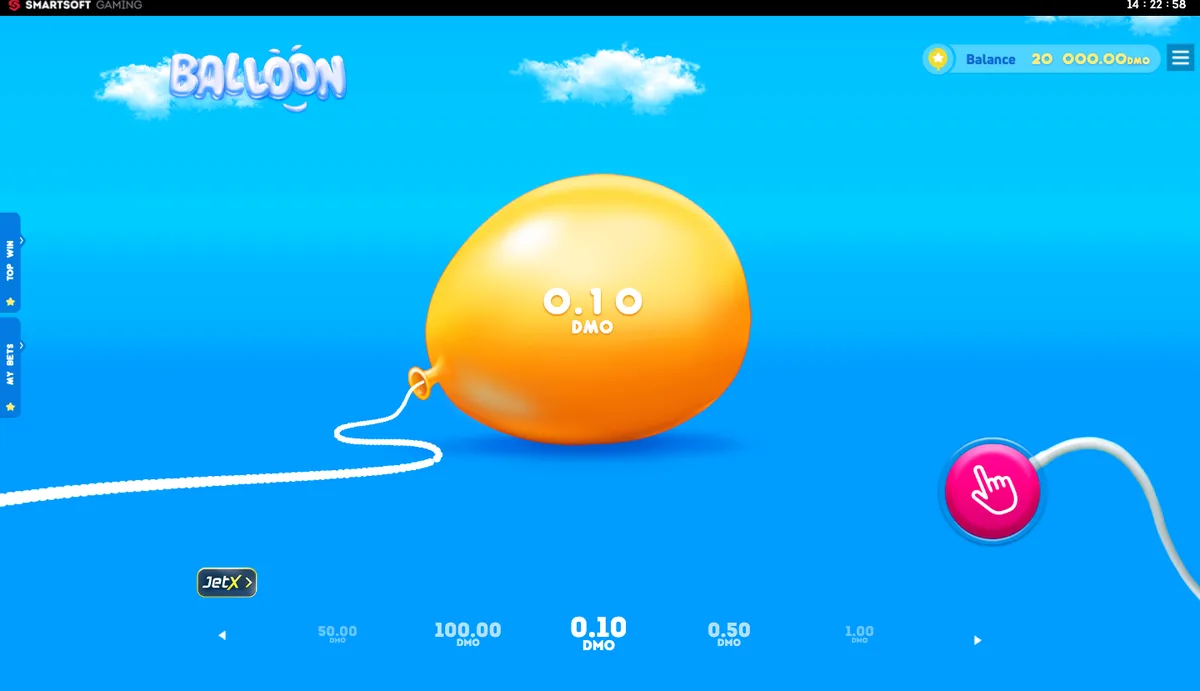
How does the Balloon multiplier work?
The Balloon multiplier is the number that grows on the screen as the balloon inflates. Each round of Balloon follows the same sequence: you place your bet before the start, the counter starts at x1.00 and goes up, and you decide when to cash out. If the balloon bursts before you press the withdrawal button, your bet in that round is lost.
The game has no secret phases or hidden bonuses that alter that logic. According to reviews, it also does not include automatic withdrawal, so the time to cash out depends on you following the round and reacting on time. It is advisable to confirm this in the rules of the version you open.
Withdraw in x2: what it means in Balloon
It means that the notional value is doubled if cashout occurs at that moment. For example, a ₹10 demo stake settled at x2 shows a ₹20 return, including the original ₹10. The formula is the amount multiplied by the cashout value. What the balloon does afterwards no longer affects that result.
How much do they pay x5, x10 and x100
Each value indicates how much the bet is multiplied by if you collect right at that point. With a bet of 10 units:
| Display value | You receive (bet of 10) | In words |
|---|---|---|
| x2 | 20 | You double your bet |
| x5 | 50 | Five times the bet |
| x10 | 100 | Ten times the bet |
| x100 | 1,000 | One hundred times the bet |
The table shows the payout if the balloon gets there, not how often it happens. The higher the value, the fewer rounds reach it, but SmartSoft Gaming does not publish an official table with the probability of each multiplier.
What is the maximum Balloon multiplier?
The review sheets indicate a maximum of x10,000. Some also mention that the actual payout per round may have its own limit, different from the number that appears on the screen; If that detail matters to you, check the rules of the version you play, because the maximum winning amount should appear there. In any case, approaching that ceiling is something exceptional.
Does more multiplier equal more chance of winning?
It’s the other way around. A high multiplier means a bigger prize if you hit it, not more chances to hit it. A 100x pays one hundred times the amount bet, but in the logic of crash games there are many more rounds that end before that point than those that exceed it. Aiming far away increases the size of the possible prize and, in turn, the number of times the balloon pops before cashing out.
Do previous rounds influence the multiplier?
No. Each round is solved separately with a random number generator on the provider’s server. A series of balloons that burst soon does not make it more likely that the next one will go high, and a very high round does not herald a fall. The same principle explains why the return percentage, discussed in the Balloon RTP guide, only makes sense over huge volumes of rounds.
Is there a way to predict the next multiplier?
There is no reliable method to know in advance where the counter will stop. The applications and channels that claim to do so do not show how they would obtain that data; In the article about Balloon Predictor we review its promises and risks.
Example of a session with different collection objectives
An example with round numbers helps to see the effect of the multiplier in practice. Assume a fixed bet of 8 units per round, for 10 rounds in a row:
In six of those rounds you cash out early, around x1.3, and win about 2.4 net units each time: in total, about 14 units in favor. In three rounds the balloon bursts before you get to collect, and you lose the 8 units bet on each one: 24 units against. In the remaining round you take a risk and manage to withdraw at x6: you receive 48 units for that bet of 8, with a net profit of 40.
Adding the entire block of 10 rounds, the result is in favor by about 30 units, and that single high round is the one that pushes the entire balance up. Change the order of the rounds, or remove that single high round, and the result of the same session looks completely different. That’s how sensitive a small sample is to what happens in a few specific rounds.
Common mistakes when handling the multiplier
- Always pursue the same payment number without ever adjusting it, even if the session budget has already changed.
- Upping the ante after a streak of balloon popping early, thinking you’ll “hit” a high multiplier soon.
- Focus only on the x10,000 that appears as the limit and lose sight of the fact that real rounds almost never come close to that number.
- Decide the cash point at the last second, watching the counter go up, instead of setting a goal before the round starts.
Multiplier vs manual collection: why Balloon requires to be present
This point connects with something that was already mentioned at the beginning: Balloon does not have automatic cashout. In other crash games you can set a number beforehand and let the system collect for you if the multiplier reaches there. In Balloon that option does not exist, so the multiplier you see on the screen only becomes a payment if you, in person, touch the button in time.
That difference changes the way you play more than any strategy about which number to chase: it requires constant attention round after round, and a one-second distraction can cost you the entire bet even if the mental goal was reasonable. The note on cash out early or wait in Balloon delves into that decision mechanic without going into the scope of this guide.
Does it make sense to chase high multipliers?
It depends on what you’re looking for and how much you’re willing to risk, not a mathematical advantage. Waiting for x50 or x100 means accepting many lost rounds for each success, and that requires a budget that supports it. Withdrawing at low values gives more frequent, but small, charges. Neither option improves the theoretical return of the game: they only change the pace of wins and losses. If you decide to go for high values, reduce the size of each bet and define beforehand how many rounds you are going to play.
Frequently asked questions
How much do I charge if I withdraw in x5? Five times the amount. With a ₹10 demo value, the displayed return is ₹50.
How high can the Balloon multiplier go? Reviews quote x10,000 maximum. The actual payout limit for each version is listed in its rules.
Is it harder to reach a high multiplier? Yes, in general: the higher the value, the fewer rounds reach it. There is no official table with the probability of each number.
Does what happened in the previous rounds change the next one? No. Each round is independent of the others.
Is it better to always wait for a high multiplier? There is no better option in mathematical terms. It is a risky choice that must fit your budget.
What happens if I can’t get paid before the balloon bursts? You lose the entire bet for that round. Since there is no automatic cashout in Balloon, that risk depends entirely on your own reaction.
Does the counter always start from the same value each round? Yes, every new round starts at x1.00 without exception, no matter what number the previous round ended at.
Does it help to review the multipliers from past rounds when choosing my next target? It does not provide any real advantage, because each round depends on a random number generator independent of the previous ones. Watching the history can help you understand the overall pace of the game, but not guess the next outcome.
Balloon is a game of chance and no multiplier pattern guarantees an outcome. Online money gaming is prohibited in India under the Promotion and Regulation of Online Gaming Act, 2025. Use demo mode for learning and read the responsible gaming notice.
Inside the Balloon demo